Save money on college just by opening your email
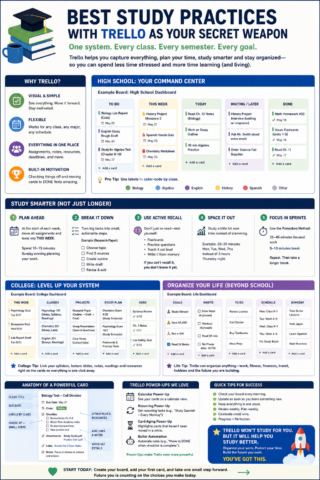
Trello: Your Secret Weapon for Studying, College & Life
One Simple System to Organize Your Schoolwork, Your Time—and Eventually, Just About Everything
There is a sentence almost every student has heard:
“You need to study.”
Okay.
But how?
How do you keep up with six or seven classes, homework, tests, projects, practices, activities, work and everything else happening in your life?
And once you sit down to study, what should you actually do?
Here’s the good news:
Being organized isn’t something you’re either born knowing how to do or doomed to be terrible at forever.
It’s a skill.
And one of our favorite tools for learning that skill is Trello.
Trello is a visual organization system that lets you take everything swirling around in your brain and put it somewhere you can actually see it, organize it and act on it.
We’re going to show you how to use Trello to create your own personal command center.
But we’re also going to teach you something more important:
How to study well.
Because Trello can’t learn chemistry for you.
But it can make sure you know exactly what to do when it’s time to learn chemistry.
First: Learn the Trello Basics
NEW TO TRELLO? WATCH THIS FIRST.
In this short tutorial, we’ll show you the basics of using Trello, including boards, lists, cards, labels, due dates and attachments.
Once you understand those basics, you’re ready to build your system.
PART ONE: Build Your High School Command Center
Create a Trello board called:
MY SCHOOL COMMAND CENTER
Start with these lists:
INBOX → THIS WEEK → TODAY → STUDYING → WAITING → DONE 🎉
Here’s what each one does.
INBOX
Something new comes up?
Put it here.
Homework assignment.
Test.
Project.
Permission slip.
Something you need to ask your teacher.
Book you need to bring to school.
Don’t trust yourself to remember it later.
Capture it.
Your brain is much better at thinking than remembering 47 random things.
THIS WEEK
Once a week, look ahead and move everything that needs your attention into THIS WEEK.
This is where you see the big picture.
TODAY
Every day, choose what you realistically need to accomplish.
Don’t put 19 things here.
Choose the things that actually need your attention today.
STUDYING
This is for things you’re actively preparing for.
Tests.
Quizzes.
Presentations.
Papers.
Anything requiring more than one work session.
WAITING
Waiting for your teacher to answer a question?
Waiting for your group-project partner?
Need your parent to sign something?
Put it here.
Now it isn’t occupying space in your brain.
DONE
Keep this list.
There’s something wonderfully satisfying about dragging an assignment into DONE.
Don’t underestimate the motivation that comes from seeing what you’ve accomplished.
PART TWO: Make Every Class Easy to See
Create a different Trello label for each class.
For example:
Biology
Algebra II
English
World History
Spanish
Art
Now when you look at your board, you can immediately see which class each card belongs to.
Your board becomes a visual map of your workload.
And this is where Trello starts becoming powerful.
PART THREE: Stop Writing “Study for Biology”
This may be one of the biggest changes you make.
A card that says:
Study for Biology Test
isn’t particularly helpful.
What does “study” actually mean?
Instead, create:
BIOLOGY TEST: CELL DIVISION
Test: Friday
Then add a checklist:
☐ Review class notes
☐ Read textbook section
☐ Make flashcards
☐ Review vocabulary
☐ Draw mitosis from memory
☐ Answer practice questions
☐ Review questions I missed
☐ Teach the concept to someone
☐ Final 10-minute review Friday morning
Now you have a plan.
This works for projects, too.
Don’t create:
HISTORY RESEARCH PAPER
and then avoid looking at the card for three weeks because it feels enormous.
Break it down:
☐ Choose topic
☐ Get topic approved
☐ Find five reliable sources
☐ Read sources
☐ Write thesis
☐ Create outline
☐ Draft introduction
☐ Write first section
☐ Finish first draft
☐ Add citations
☐ Edit
☐ Proofread
☐ Submit
Big projects create anxiety.
Small actions create progress.
PART FOUR: Put Everything You Need Inside the Card
Imagine opening your Biology Test card and finding:
Due date: Friday
Checklist: Your study plan
Attachments: Study guide + class notes
Links: Quizlet + teacher’s review video
Notes: Chapters 6–8
Question for teacher: Review #14
Now when it’s time to study, you don’t spend the first 20 minutes trying to figure out what you’re supposed to study.
Everything is there.
That’s one of the secrets of good organization:
Make it easy for Future You to begin.
PART FIVE: Now Learn HOW to Study
Getting organized is only half the equation.
You also need to know how your brain learns.
And unfortunately, some of the things students call “studying” aren’t particularly effective.
Reading the same page six times while highlighting half of it in yellow may feel productive.
But there’s a better way.
1. Use Active Recall
One of the best ways to learn something is to force your brain to retrieve the information without looking at the answer.
Read something.
Close the book.
Now ask:
What do I remember?
Try:
- Flashcards
- Practice questions
- Writing what you remember on blank paper
- Explaining the concept aloud
- Teaching it to someone
- Drawing a diagram from memory
- Creating your own quiz
Here’s how Trello helps.
Inside your study card, add:
☐ Answer 10 questions WITHOUT notes
☐ Write everything I remember about photosynthesis
☐ Explain mitosis aloud
☐ Review what I couldn’t remember
Notice the difference?
You’re no longer telling yourself:
Study Biology.
You’re telling yourself exactly how to study Biology.
2. Space It Out
Let’s say your chemistry test is Friday.
Please don’t make Thursday night your first date with Chapter 7.
Instead, put this checklist inside your Trello card:
MONDAY — 20 minutes
Review notes + vocabulary
TUESDAY — 25 minutes
Practice problems
WEDNESDAY — 25 minutes
Active recall + flashcards
THURSDAY — 30 minutes
Practice test + review mistakes
FRIDAY — 10 minutes
Quick review
That’s called spaced practice.
You’re returning to the material repeatedly instead of trying to cram everything into your brain at once.
And yes, it requires a little discipline earlier in the week.
But remember:
Discipline buys freedom.
Thirty minutes Wednesday can save you from a panicked three-hour Thursday night.
3. Study in Focused Sprints
You don’t have to sit at your desk for four hours.
Try working for:
25–45 focused minutes
Then take:
5–10 minutes off.
During the focus period:
Put your phone somewhere else.
Close the tabs you don’t need.
Turn off notifications.
Choose ONE Trello card.
Work on ONE task.
Then take your break.
Focused work beats distracted work almost every time.
4. Study According to the Subject
Don’t study every class the same way.
MATH
Do problems.
Watching someone else solve a problem isn’t the same as solving it yourself.
Create a Trello checklist:
☐ Complete 10 practice problems
☐ Mark the ones I miss
☐ Figure out WHY I missed them
☐ Redo missed problems tomorrow
SCIENCE
Use:
Flashcards
Diagrams
Practice questions
Active recall
Teaching aloud
Instead of looking at a diagram of the heart, try drawing and labeling it from memory.
HISTORY
Don’t only memorize dates.
Ask:
What happened?
Why did it happen?
What changed because of it?
Create timelines and connect events.
ENGLISH
For literature, focus on:
Characters
Themes
Important passages
Motivations
Connections
For writing assignments, use Trello to break the process into:
IDEA → OUTLINE → DRAFT → EDIT → FINAL
FOREIGN LANGUAGE
Short, frequent practice wins.
Ten or fifteen minutes most days will usually serve you better than one giant vocabulary cram session.
PART SIX: Create an “I DON’T UNDERSTAND THIS” List
Add one more list to your school board:
ASK / NEED HELP
This might be one of the smartest lists you create.
Cards might say:
Ask Mr. Jones about Algebra problem #17
I still don’t understand ionic bonds
Ask teacher how thesis should be formatted
Need help with Spanish verb tense
Then actually ask.
Successful students aren’t students who understand everything immediately.
They’re students who notice when they don’t understand something and do something about it.
PART SEVEN: The 15-Minute Sunday Reset
This is the habit that makes the entire system work.
Once a week, open Trello.
Set a timer for 15 minutes.
Then:
☐ Open your school portal
☐ Check every class
☐ Add new assignments
☐ Add upcoming tests
☐ Look at the next TWO weeks
☐ Check project deadlines
☐ Break large projects into steps
☐ Move priorities into THIS WEEK
☐ Check ASK / NEED HELP
☐ Decide what needs to happen Monday
Done.
Go enjoy Sunday.
Those 15 minutes can completely change the way your week feels.
PART EIGHT: Take Trello to College
Here’s where this gets really good.
You aren’t learning a system you’ll abandon after graduation.
Take it with you.
Your college Trello board might include:
INBOX
THIS WEEK
CLASSES
READING
EXAMS
PROJECTS & PAPERS
CAREER / INTERNSHIPS
DONE
At the beginning of every semester, take each syllabus and enter the major dates into Trello.
Midterms.
Finals.
Papers.
Projects.
Presentations.
Major reading assignments.
Then work backward.
If a 15-page research paper is due November 20, November 19 shouldn’t be:
Start research paper.
Instead:
October 15 — Choose topic
October 20 — Begin research
October 27 — Sources complete
November 1 — Outline
November 5 — Begin draft
November 12 — Draft complete
November 15 — Edit
November 18 — Final proofread
November 20 — Submit
Welcome to college without the 2 a.m. panic.
PART NINE: Use Trello to Organize Your Life
Here’s the secret:
Eventually you may not need Trello primarily for school.
But you may still need Trello.
Create a:
LIFE DASHBOARD
Your lists might include:
THIS WEEK
MONEY
APPOINTMENTS
HEALTH & FITNESS
WORK
TRAVEL
GOALS
SOMEDAY
DONE
Suddenly Trello can help you manage:
A job search.
A vacation.
Your budget.
A home project.
A wedding.
A fitness goal.
A business idea.
Graduate school applications.
A move.
Your first apartment.
Your someday list.
You can even create separate boards for major parts of your life.
The Bigger Lesson
We’re showing you how to use Trello.
But Trello isn’t really the lesson.
The lesson is learning how to take something big and make it manageable.
Capture what needs to be done.
Decide what’s important.
Break big things into small things.
Schedule time to do them.
Focus on one thing at a time.
Ask for help when you’re stuck.
Finish.
Move forward.
Those skills work whether you’re 15, 25 or 55.
Your Trello Study Formula
When school starts feeling overwhelming, remember:
CAPTURE → ORGANIZE → BREAK IT DOWN → SCHEDULE → FOCUS → REVIEW → DONE
Don’t rely on your memory.
Don’t wait until you “feel motivated.”
Don’t try to do everything at once.
Build a system.
Then trust the system.
Because the goal isn’t to become the student who spends every waking hour studying.
The goal is to become the student who knows:
what needs to be done,
when it needs to be done,
and how to get it done.
And that’s much bigger than getting through high school.
You’re learning how to manage your life.